
Foster carers across Wales share the small, meaningful breakthroughs that signal growing trust and emotional safety.
Foster Wales wanted to shine a light on the everyday experiences of fostering, from the highs to the lows – and everything in between. And what better way to do that, than by hearing it first hand from our amazing Foster Carers. We developed a survey, inviting foster carers to share their experiences of caring for children.
The insights we got back offered a deeper understanding of the day-to-day challenges that carers face, and how progress can happen when things like routine and consistency are introduced into a child’s life.
Alastair Cope, head of Foster Wales, said: “This survey shows us just how complex and emotionally intense the role of fostering can be. But it also shows us that with the right tools, training and support, it can be life changing both for carer and child.”
Here are the top 5 things our survey found…
the survey results
trauma-related behaviour
The survey found that most foster carers have experience of caring for a child with trauma-related behaviours.
“The hardest part is the lack of self-worth one child feels… and the constant need for negative emotion just to feel anything,” – foster carer.
The most common behaviour identified by foster carers in the survey was intense emotional reactions or difficulty regulating feelings, with 81% of respondents stating they had witnessed this behaviour. Secondly, 80% said they had experience of challenges around boundaries.
confidence increases with experience
We know that feelings of nervousness are completely normal for new foster carers, but we are so pleased to learn that those feelings quickly grow into confidence with time, experience and training.
“I’ve almost 20 years of fostering… I cannot advocate enough the need to learn and develop constantly,” – foster carer.
The survey found that carer confidence increases significantly over time, rising from an average of 2.8 (rating out of 5) at the start of their journey to 4.5, demonstrating the impact of experience and support.
Most respondents (65%) said the training provided by Foster Wales or their local authority contributed to this increase in confidence.
Almost all foster carers (93%) report feeling confident in dealing with trauma-related behaviours, out of which 56% feel ‘extremely confident’.
progress takes time
We know from the survey that many children and young people who come into care have trauma-related behaviours. Foster carers were asked to pinpoint how long it has taken them and the children they cared for to make meaningful change.
“She was my shadow… slowly over time she would happily play in my living room while I chatted to her from the kitchen.”
The most common time frame identified by the survey was 3-6 months.
success in the small moments
Responses show that a “shift” in fostering is rarely defined by one dramatic moment, but instead by a series of small, meaningful breakthroughs that signal growing trust and emotional safety.
For many foster carers, these moments are subtle but deeply significant. Early signs of progress often include children beginning to seek comfort or show physical affection, even in small ways.
“When she started asking for hugs… it still counted,” – foster carer.
Another sign of progress mentioned in the survey is when children begin to talk more openly and engage in everyday family life.
“When they started talking to us about their day… that’s when we knew trust was building.” –foster carer
Moments of joy and emotional expression are also important markers of progress, according to the survey. Several carers described the significance of seeing a child laugh or relax for the first time.
“That first smile was everything.” – foster carer
Importantly, many responses emphasise that these changes do not happen overnight. Progress in fostering is defined by trust, connection, and a sense of safety, often shown through small but meaningful changes over time.
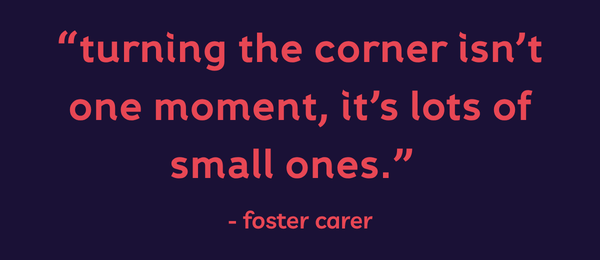
“Turning the corner isn’t one moment, it’s lots of small ones.” – foster carer.
support that works
We know that the more you do something, the better you get, and the survey results show that this transpires into stronger feelings of confidence. Foster carers overwhelmingly attribute increased confidence to gaining experience, with 90% selecting this as a key factor.
However, it is so clear to see that support from social workers and other foster carers plays a massive role in a foster carer’s journey.
“The biggest difference is having such an amazing support system around us.” – foster carer.
Foster carers said that support from supervising social workers (71%), training (65%), peer support from other foster carers (56%) and self-directed learning (64%) all contributed to an increase in confidence.
about the survey
Conducted between 24th March and 9th April 2026 via an online form among local authority foster carers. A total of 119 responses were received, including 118 in English and 1 in Welsh. Responses were received from foster carers from every local authority across Wales.